Play-to-earn sounds simple: play a game and earn something with real value. But if you are looking at a crypto game and wondering how does play-to-earn work economically, that simple explanation is not enough.
- Where do the rewards come from?
- Why does one player earn more than another?
- What keeps those rewards going?
- And what happens when thousands or even millions of players are competing for them?
Those are the questions worth asking before you put serious time into any play-to-earn game.
RollerCoin gives you a useful example because its economy turns gameplay, Mining Power, Miners, upgrades, events, and crypto rewards into one connected system.
Let’s break down what is actually happening behind that Play button.
Where Does the Value in Play-to-Earn Come From?
A play-to-earn economy is not a machine that creates unlimited money every time somebody plays.
Think of it as a system that connects player activity, game resources, progression, competition, and a reward pool. Different games arrange those pieces differently.
You might play to earn an in-game token. Another game might reward tradable items. Others use NFTs, currencies, resources, or access to competitions.
RollerCoin takes another approach: your activity can increase your Mining Power, which determines your potential share of crypto rewards. That distinction matters.
Playing a mini-game does not magically generate Bitcoin from nothing. In RollerCoin, games can give you temporary Mining Power. That power then becomes part of the game’s mining simulation and affects your share of the available reward pool.
This creates an economic loop. Players spend time playing, collecting, upgrading, and making decisions. The game gives those actions utility through progression and rewards.
The important question is therefore not just “Can I earn?”. It is also “What creates demand for the resources I am earning or using?”
A healthier crypto gaming economy gives players reasons to use resources inside the game instead of making cashing out the only meaningful objective.
How Does Play-to-Earn Work in RollerCoin?
Let’s make the economics less abstract. When you enter RollerCoin, you get a virtual mining room. Instead of buying physical ASICs, paying an electricity bill, and actually mining cryptocurrency, you build Mining Power inside a simulation.
One way to get started is simply by playing:
- Mini-games can generate temporary Mining Power
- Miners placed in your room provide permanent Mining Power
- Upgrades, bonuses, events, and other systems can affect your setup over time.
RollerCoin’s current Bitcoin mechanics, for example, distinguish between temporary Power from games and permanent Power from Miners.
Then comes the part that matters economically: your Power exists relative to everybody else’s Power.
If you allocate your Mining Power to BTC, your possible share of the Bitcoin reward pool depends on your Power compared with the total Power allocated to that pool. More Power can mean a larger possible share, but rewards also depend on variables such as the reward pool and total network Power.
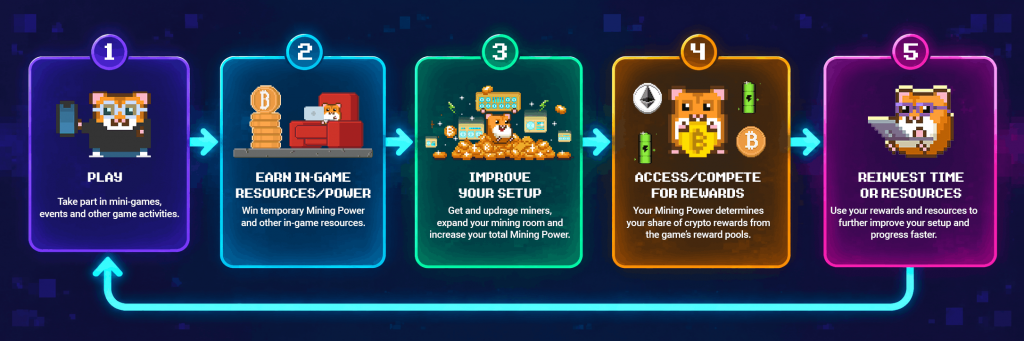
So the basic RollerCoin loop looks like this:
Play → Gain Power → Build your mining room → Allocate Power → Receive a share of rewards → Improve your setup
That is much closer to how play-to-earn economics actually works than “play a game, get free money.”
Want to see the model in action? Explore how the RollerCoin as a Play2Earn game connects gameplay with crypto rewards.
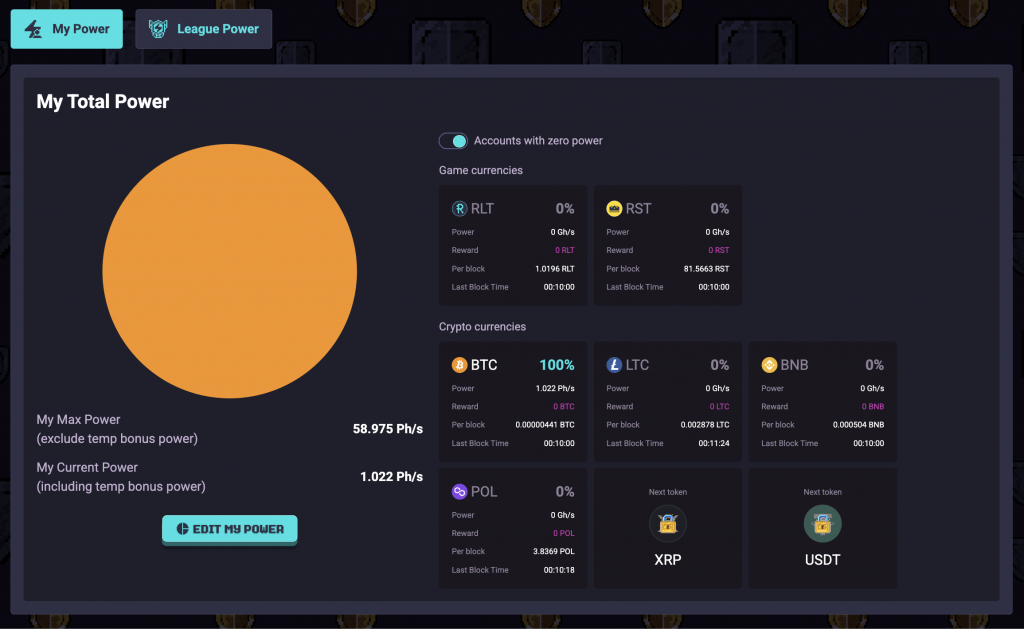
Your Time Is Part of the Economy Too
Here is something easy to miss when talking about “free” play-to-earn games: your time has value. You may be able to start without buying anything, but that does not make the economic cost zero. You are still deciding where to spend your time and attention.
Suppose two Rollers start with no purchases:
- Roller 1: plays occasionally.
- Roller 2: plays regularly, completes activities, participates in events, and gradually improves their mining room.
Their results are unlikely to remain identical because their activity and accumulated Mining Power are different. This is why “free to start” and “guaranteed income” are completely different claims.
RollerCoin lets players generate Mining Power through gameplay without physical mining hardware. For example, players can allocate that Power toward earning Bitcoin through the mining simulator. The amount received is not fixed simply because somebody played a certain number of games.
If you are a Roller, you are effectively making resource-allocation decisions:
- Where should your Power go?
- Which upgrades matter to you?
- Is an event worth your time?
- Should you focus on temporary Power or grow your permanent setup?
That is gameplay, but it is also economics.
What Makes a Play-to-Earn Economy Sustainable?
This is where you should become a little skeptical.
A play-to-earn economy becomes difficult to sustain if its entire logic depends on new players arriving and putting value into the system so earlier players can continuously extract it.
A stronger model needs more going on inside the game.
- Utility matters: Think on how resources should have reasons to exist beyond immediately converting them into something you want to withdraw.
- Progression is important: Players need goals that make improving an account, collection, character, equipment, or setup meaningful.
- Competition is the core: Rankings, events, challenges, collections, and other game systems can create reasons to participate that are not simply “cash out as quickly as possible.”
- Reward mechanics are needed. Players should be able to understand what affects their rewards rather than assuming that playing automatically produces a fixed income.
In RollerCoin, for example, Mining Power is central to the reward mechanic. A player’s potential BTC share depends on their Power relative to the pool, while gameplay, Miners, upgrades, events, and bonuses provide different ways of developing that Power.
That does not mean you should assume any play-to-earn economy will remain sustainable forever. It means you have concrete mechanics you can examine instead of relying on the word “earn.”
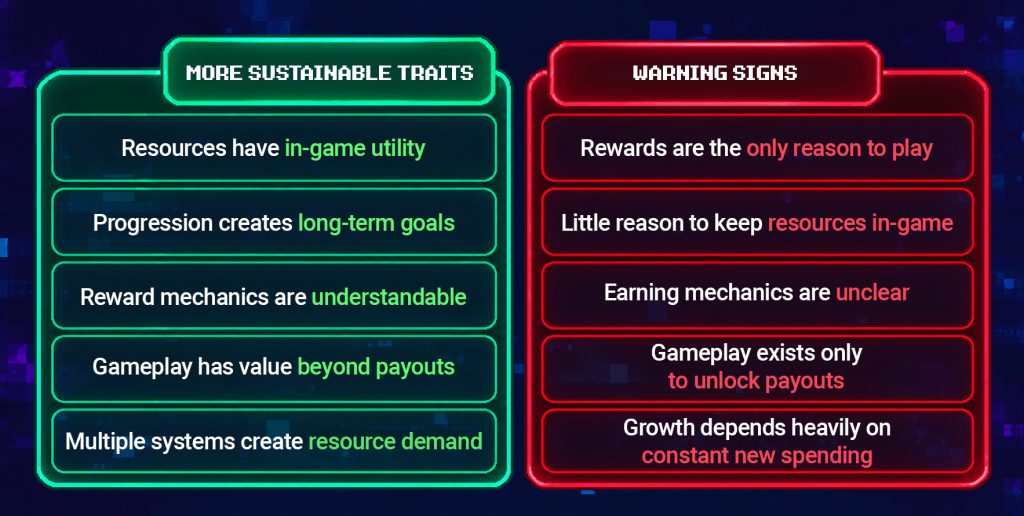
Common Play-to-Earn Misconceptions
Let’s clear up a few things that often get misunderstood about play-to-earn games.
- “Earn” does not mean guaranteed profit. Your rewards may depend on your activity, account progression, game mechanics, competition from other players, reward-pool size, asset values, or several of those factors at once.
- “Free” doesn’t mean your time has no cost. Spending three hours earning a reward is still an exchange. Whether that exchange makes sense is something each player should judge for themselves.
- Earning an in-game resource is not the same as receiving something you can actually withdraw. Always check what the game rewards, whether that asset can leave the platform, minimum withdrawal requirements, fees, and any conditions attached to withdrawals.
- Spending doesn’t automatically mean earning more than you spent. Buying an upgrade may improve your position inside a game’s economy, but that is not the same as guaranteeing a financial return.
If you are interested in another concrete example, RollerCoin’s Ethereum page shows how gameplay, Mining Power, mining-room development, and ETH rewards are connected.
Is Play-to-Earn Worth It?
There is no universal answer because players are looking for different things.
Instead, ask yourself a few better questions.
- Would you still enjoy the game if the rewards were small?
- Can you understand exactly what determines your rewards?
- Does progression have a purpose beyond withdrawing value?
- Can you start without spending?
- And if you decide to spend later, do you understand what you are actually buying?
Most importantly, separate possible rewards from expected income.
Play-to-earn makes much more sense once you stop thinking of it as “money for playing” and start looking at the economy underneath it.
Understand what you earn, why it has utility, what determines your share, and what you are giving in return, whether that is time, attention, or money. Then you can decide whether the game itself, and not just the word “earn,” is worth your time.
If you are joining RollerCoin specifically, our RollerCoin strategy for beginners goes deeper into what a new Roller should prioritize during the first month.
 Referral program
 Leaderboard
 How it works
 FAQ
FAQ